

As vehicle safety systems become increasingly sophisticated, one misconception persists: every new safety feature requires another sensor. Need driver monitoring? Add a camera. Want occupant monitoring? Install another. Gesture control? Add a time-of-flight sensor. Digital mirrors? More hardware.
The reality is moving in the opposite direction.
The automotive industry is shifting towards centralized, software-defined architectures where a single in-cabin camera can simultaneously support multiple safety, comfort and convenience functions. Rather than deploying dedicated hardware for each application, manufacturers are increasingly leveraging advanced computer vision and artificial intelligence to extract multiple layers of information from the same video stream.
The result is a vehicle that understands far more about its occupants without adding complexity.
A Camera Doesn't See Objects. Software Does.
An image sensor simply captures pixels. It has no understanding of whether it is looking at a face, a steering wheel or a passenger leaning forward.
The intelligence lies entirely within the software.
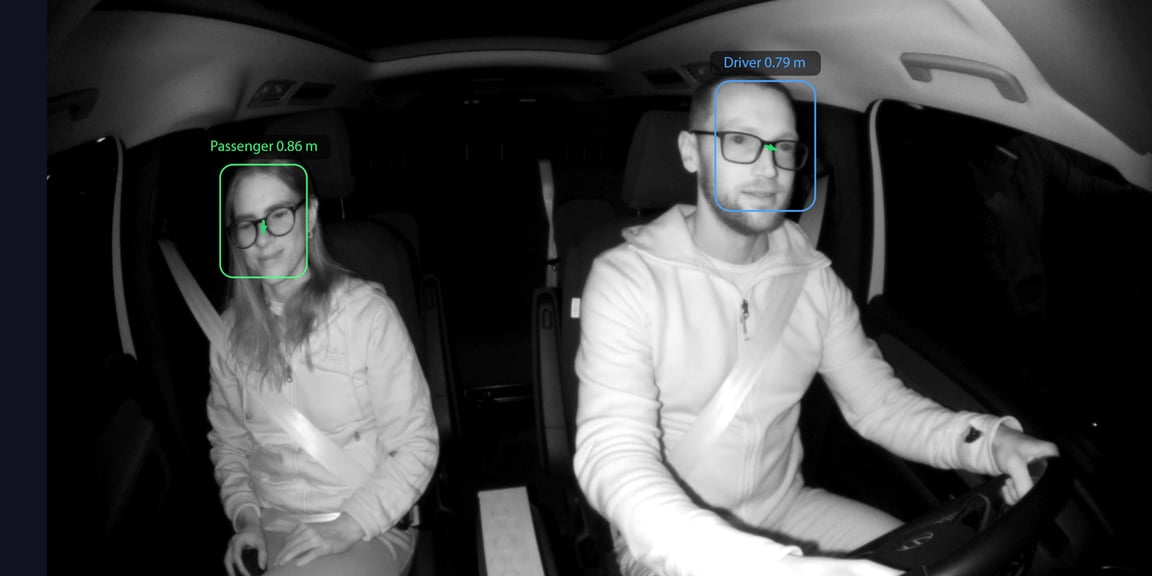
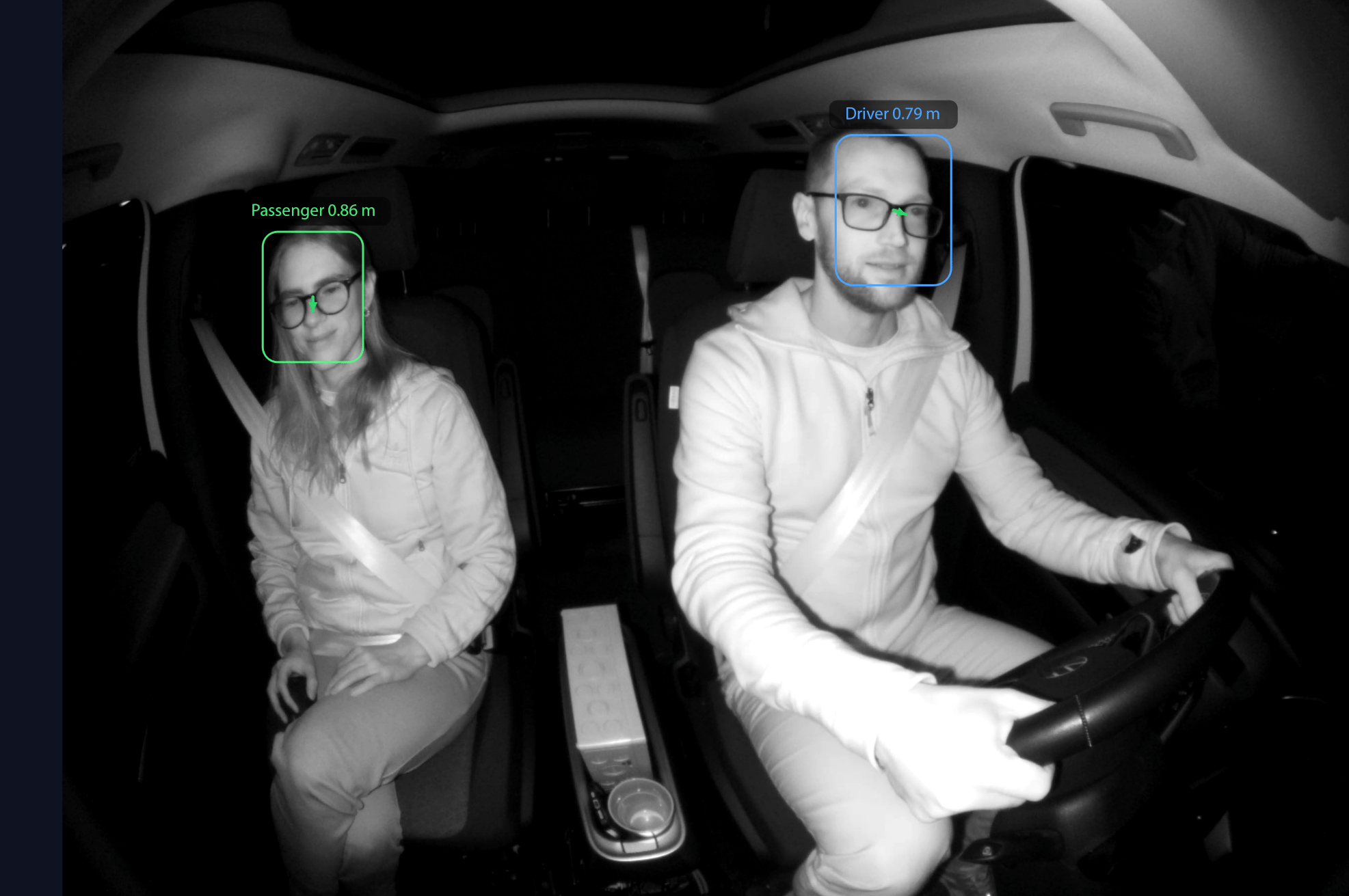
Neonode’s computer vision system, MultiSensing, transforms a continuous stream of two-dimensional images into meaningful information by running a series of highly specialized neural networks. Each network has a specific task or set of tasks, as well as processing logic. These can include detecting facial landmarks, estimating head pose, locating hands, identifying body posture or determining the three-dimensional position of occupants within the cabin.
Rather than asking one large neural network to solve every problem, Neonode's platform divides the workload into multiple lightweight models, each optimized for a particular task. This modular approach improves robustness, reduces computational requirements and allows new capabilities to be added without redesigning the entire system.
One Image, Many Interpretations.
The remarkable aspect of an in-cabin camera, even those of low quality, is that every frame can be analyzed in several different ways simultaneously.
A single image may be processed to determine whether the driver is looking at the road, whether both hands are on the steering wheel, if the front passenger is leaning dangerously close to the dashboard/airbag, whether a seatbelt is routed correctly, and whether a digital mirror should adjust its viewing perspective based on the driver's head position.
These are not separate camera systems performing independent analyses. They are different interpretations of the same visual information.
This layered approach allows multiple safety and convenience functions to operate concurrently while sharing the same hardware platform.
Building a Three-Dimensional Understanding.
Many in-cabin sensing applications require more than simple object recognition. They require spatial understanding.
Knowing that a passenger's head has been detected is useful. Knowing precisely where that head is located relative to the dashboard, steering wheel or even sound speakers is significantly more valuable.
Recent advances in machine learning have enabled an alternative approach.
Monocular depth estimation allows software to infer three-dimensional position using a single conventional camera. By analyzing perspective, scale, shading and learned visual relationships, neural networks estimate the distance between the camera and objects throughout the cabin without requiring specialized hardware.
Neonode’s 3D depth positioning is centimeter-level accurate, which enables applications ranging from out-of-position detection to Digital Mirror Augmentation, where the displayed mirror image follows the driver's head movement to replicate the experience of looking into a traditional mirror, rather than a static screen.
Designed for the Software-Defined Vehicle
As software-defined vehicles become the industry standard, manufacturers are increasingly seeking technologies that are camera agnostic, hardware efficient and capable of supporting new functionality through software rather than hardware redesign. Using a single in-cabin camera allows new capabilities to be introduced through over-the-air updates, extending vehicle functionality long after production.
However, processing multiple AI workloads inside a vehicle presents a unique engineering challenge.
Unlike cloud-based AI systems, automotive software operates on embedded processors with strict limits on power consumption, thermal output and available computing resources. Every millisecond of latency matters, and every additional watt affects system design.
This makes efficiency just as important as accuracy.
Rather than relying on large, computationally intensive foundation models, MultiSensing uses a modular architecture with multiple lightweight neural networks that can be dynamically prioritized. Time-critical functions, such as eye analysis, run at higher frame rates than less critical tasks like seatbelt routing detection, reducing computational load while maintaining accurate performance, even under fluctuating frame rates.
The result is that multiple perception tasks can be executed in real-time using a single processing platform.
Seeing More by Adding Less
The future of in-cabin sensing is not about filling vehicles with more cameras and sensors. It is about extracting more value from every sensor already installed.
By combining advanced computer vision, modular neural networks and monocular depth estimation, a single camera can become the foundation for a wide range of safety, comfort and human-machine interaction features. The camera captures the image once. Intelligent software interprets it many different ways.
As vehicles continue their evolution into software-defined platforms, this ability to derive multiple insights from a single source of data will become a defining characteristic of next-generation automotive systems. The smartest vehicles won't necessarily have the most sensors; they'll have the most intelligent perception.